
A snowy egret marks fall's approach.
Flocking Egrets Signal Summer's End
Near the Kent Narrows, a pine tree forest embraces a shallow pond where hundreds of egrets forage, gracefully striding and probing undisturbed. From certain angles, the baby blue sky and still waters merge into one palette, and the majestic birds appear to saunter throughout the heavens. When egrets begin to flock, I know summer is nearing an end, and cooler temperatures are just around the corner.
In September, the usually solitary birds congregate in wetlands to feed and build energy reserves in preparation for migration to wintering homes in the Caribbean, Central America, and South America. Both Great Egrets (yellow-billed) and Snowy Egrets (black-billed) migrate at the same time, sharing flyways, stopover grounds, and winter destinations, but they stay within their own flocks during flight to accommodate the speeds of each species. Great Egrets have a larger wingspan, around five feet, while the wingspan of snowies is smaller at three and half feet.
At this time of year it’s not uncommon to see stately Great Egrets hunting the shallows for fish, reptiles, and insects, alongside Yellowlegs, snowy egrets, and sandpipers. These shorebirds all share the same staging and stopover grounds. In another month or so, this pond will become habitat for ducks, geese, and swan migrating from Alaska, Canada, and the Arctic tundra to overwinter with us here on the Chesapeake Bay. What a blessing to have organizations that preserve these habitats.
The Great Egret is a conservation success story, as the shorebirds rebounded from near extirpation around a century ago. The regal bird is the symbol of the National Audubon Society and for good reason. The birds were hunted to near extinction in the late 19th and early 20th centuries when the egret’s showy breeding plumes commanded top dollar as ornamentation for ladies’ hats. According to Smithsonian Magazine, the delicate sprays of breeding plumage, called aigrettes, were quite literally worth twice the amount of gold. Aigrettes only develop during the spring breeding season. Hunters would slaughter an entire colony of birds, leaving hatchings subject to predation and starvation.
Two Boston socialites, Harriet Hemenway and her cousin, Minna Hall, acted on behalf of the voiceless birds, safeguarding their existence. They held tea parties, rallying friends to ban the wearing of hats adorned with bird feathers. Their efforts ballooned into a movement when 900 women formed an organization—the Massachusetts Audubon Society—which evolved to become the National Audubon Society. Their rebellion against plume hunters further led to the passage of the Migratory Bird Treaty Act in 1918. Today, the treaty protects over 1,000 birds including hawks, owls, songbirds, and swans. (Sadly, prior to the passage of the act, the magnificent east coast Trumpeter Swan was extirpated; attempts to reintroduce a migratory flock have failed although there are some reports of interior populations pushing into the Atlantic Flyway. Personally, I have yet to spot any Trumpeter Swans on Maryland’s Eastern Shore.)
The birds faced a second threat a couple of decades later when the chemical DDT was
introduced to protect soldiers fighting in World War II from diseases carried by insects. Discoveries that DDT caused the thinning of bird eggshells leading to hatching failures prompted marine biologist Rachel Carson to expose the dangers of synthetic pesticides in her book Silent Spring. Her environmental advocacy incited an environmental movement which lead to the banning of DDT in 1972, the formation of the Environmental Protection Agency, governmental regulation of pesticide use, and the creation of Earth Day. Once threatened species such as the Great Egret, Bald Eagle, and Brown Pelican made incredible rebounds.
Today, migratory birds face a new threat: habitat loss. According to the U.S. Committee of the North American Bird Conservation Initiative’s 2025 State of Birds report, significant population declines have occurred in shorebirds, diving and dabbling ducks, waterbirds, eastern and western forest birds, sea ducks, aridland birds, and grassland birds.
Currently, the Maryland Department of Natural Resources categorizes colonial water birds such as the snowy egret as “Wildlife Species of Greatest Conservation Need.” Conservation focuses include habitat restoration and protection of key lands through a variety of partnerships with conservation groups, budget dependent. Our region along the mid-Atlantic flyway requires preservation and stewardship of productive and undisturbed stopover grounds if we are to pass along the privilege of admiring and respecting the powerful beauty of nature to our grandchildren.
Passing Along Natural Resources
“There is a delight in the hardy life of the open. There are no words that can tell
the hidden spirit of the wilderness,
that can reveal its mystery, its melancholy and its charm.
"The nation behaves well if it treats the natural resources as assets which it must turn over to the next generation increased; and not impaired in value."
--Theodore Roosevelt, 1910
Ross, Gordon. The Woman Behind the Gun. 1911.
The Woman Behind the Gun
The Woman Behind the Gun is a famous satirical color illustration by artist Gordon Ross, critiquing the millinery trade’s impact on wildlife. It depicts a woman, possibly Coco Chanel, wearing a large hat with feathers, shooting at large white birds with a rifle; two dogs labeled “French Milliner” place the dead birds on a pile at her feet. Published on May 24, 1911 in Puck magazine by Keppler and Schwarzmann, New York.
A hungry robin hatchling is ready for a feeding.
Seasons of Bloom and Fade
It’s the dog days of summer here on the Chesapeake Bay, with humid temperatures hovering in the low-90s. The wrens, robins, and cardinals have nested, and I’ve watched their young turn from defenseless hatchlings to accomplished flyers, flying off to who knows where. And though it grieves me to see so few blackberries on the bush, tomatoes are topmost, especially gracing the side of a soft crab sandwich. Each season has its rise and fall, its bloom and fade.
Summer passes quickly now. In just a few weeks, the star-blazing blooms of garlic chives and lanky purple spikes of (dis)obedience will revive the tired summer garden. Osprey will abandon channel marker perches and mudflats will embrace loose flocks of stopover egret. Yellow school buses will totter along roadways once again, slowing traffic to retrieve cherished charges. These unwavering markers whisper of fall’s approach, and so it is with utter surprise that I stumble upon a pair of nesting robins this late in the season.
Late Summer Brood
The nest is located in a weeping cherry tree, about 12 feet high. The tree’s pink blossoms have long-since faded, replaced by a canopy of serrated leaves that hangs over the nest like an umbrella.
One blistering afternoon, I find the female robin sitting motionless on the nest, her beak hanging slack. Birds do not have sweat glands, so on particularly hot days, a robin will open its beak and pant to release body heat. The female appears to be a young robin. Her beak is mostly black. As robins mature, their beaks turn yellow. Her legs are slender and smooth, unlike the thick, crusty-looking legs of her older mate. His beak is entirely yellow.
A Tender Sight
Today on my way to the garden, I pass beneath the tree and a slight movement catches my eye. There is a hatchling in the nest! Hearing my approach, it stretches its wobbly neck and opens its beak. Not receiving any food, it collapses, disappearing inside the cup. The mother looks at me with disdain, as if to say, “tease.”
It is such a tender sight to see the mother and hatchling on the nest. When the hatchling lifts its head, I can see it is nearly naked except for a scant amount of downy fuzz. Its head is much too big for its frame, with a beak that covers most of its face and large bulging circles that will soon open to reveal eyes.
On this particular day, a slender ray of sunshine finds its way through the canopy, coming to rest on the open beak of the hungry hatchling. Through my 300 mm lens, I can see tender pinkish-red tissue inside its mouth, the tissue of something newly created, fresh and full of potential. Its eyes are tightly closed and its head sports a sparse crop of straggly birth feathers.
Collaborative Parenting
During several days of observation, the female has remained on the nest with the male delivering food. Mid-day I break from gardening for lemonade on the front porch, just as the male flies into the tree with a grub in its beak. He makes several hops along branches to reach the nest and perches on its side, but his upper body is hidden from view behind a patch of leaves. I see the hatchling lift its head, but am unable to see the transfer of food. It is heartwarming though, to see the little robin family this day: the mother is most likely brooding at least another egg or two, her constant presence protecting the hatchling, and the father, for his part, busily hunting food. It seems both parents understand their roles very well, their only priority resting between them beneath the arched canopy.
In the Face of Nature
I am working in the garden the next day when a sudden cool wind descends, stirring the river to whitecaps and swaying the mottled trunks of young birch. In unison, choirs of leaves flutter and rotate, and the western sky turns leaden gray. Tall pine trees twist and drone. As I hurry to tie off deck umbrellas, a spattering of rain arrives—but quickly turns pelting. The downpour performs a drumroll on the roof and creates waterfalls that glissando across the windows. A runaway red-striped volleyball blows past. Veins of lightning shatter the black sky as I count one, two, three, four interrupted by a clap of thunder crashing like orchestral cymbals at the end of a movement and then as quickly as it arrives it departs. A blue cloudless sky breaks through.
But the storm, both revitalizing and destructive, has changed things. The air is fresh, the flora vigorously enlivened, but strewn about like fallen soldiers are branches and leaves and sundry debris blown in from neighboring yards. The churned bay is a murky brown. It will take some time for the mud to settle and water clarity to return.
Mourning
It’s a beautiful morning with the earth’s greenness restored and humidity at bay. Passing by the tree, I gaze toward the nest—it is not there! Am I looking at the wrong fork? The female robin flies in and begins hopping frantically along branches, calling out in faint, anxious repetitions, cheep cheep cheep cheep cheep. Just then, the male appears sporting a bug in its mouth and proceeds to search the tree, he too calling out softly in short staccato chirps. A slow realization occurs: was the nest knocked from the tree during the storm?
I search the ground beneath. There, amidst the ribboned leaves of liriope, sits the overturned nest; scattered nearby are the remains of broken blue eggshells licked clean. There is no sign of the hatchling.
Throughout the morning and into the afternoon, the parents fly in and out of the tree, sometimes with a bug in their bill, sometimes not, but always emitting short, mournful-sounding calls. As the afternoon wanes, the frequency of their visits decreases and the chirping dwindles. By 3:50 P.M., the tree rests in utter silence.
Across the street, the female robin perches on a green electric box partially obscured by a sumac bush whose leaves have begun to turn red. She is preening.
Short Distance Migrators
Along the Chesapeake Bay, American robins don’t migrate long distances, but move move from foraging on open lawns to dense woods that contain trees with berries. Winter robins tend to flock together in the winter, roaming woodlands in search of berried trees and shrubs. You will see flocks of robins from the north hanging around the bay region during winter.
If you’d like to attract wintering robins to your yard in the bay region, plant native species that produce berries that persist through cold weather including American Holly, Eastern Redcedar, Flowering Dogwood, Black Cherry, and Serviceberry. Favored shrubs include Winterberry, Arrowwood Viburnum, Northern Spicebush, and Staghorn Sumac.
A dozen fledglings were gathered at the cove, practicing.
Juveniles Fledge Wye River Heronry—But Where To?
By mid-July the nests in the Wye River heronry sit empty. Surely the fledglings haven’t ventured too far so we putter up and down the surrounding creeks, searching.
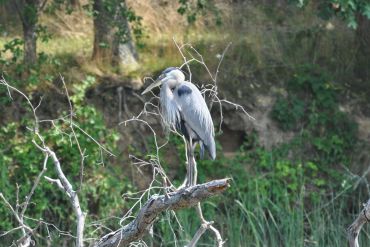
At the mouth of an uninhabited tree-lined cove just north of the breeding colony, a mature heron perches on a fallen tree. A lush crop of neck feathers falls down her chest like long fringe hanging from an alpaca scarf. She glances our way but quickly resumes focus on the cove’s end.
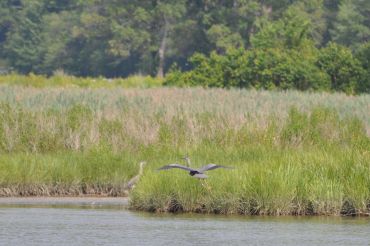
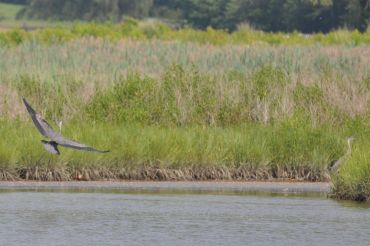
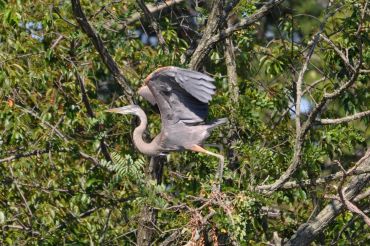
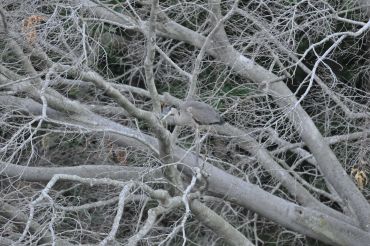
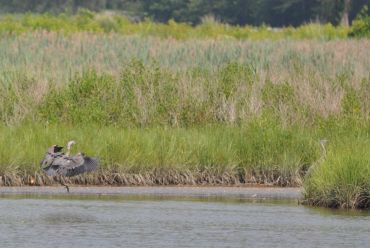
Following her gaze, we can just about make out a young heron fluttering low along the grassy shore. Wait! On closer inspection, there’s another fledgling…and another...and another. At least a dozen fledglings gather along the bank—a party of four frolics about the shoals, five perch side by side on a fallen trunk, several rest within the boughs of deciduous trees, one blends seamlessly amidst branches of dead wood, and one lone hunter works the shallows.
A fledgling nursery?
Is the mature heron watching over the fledglings?
Or perhaps her presence is mere coincidence.
Throughout our intrusion, she remains glued to her perch.
The cove is exquisitely peaceful, its shoreline embracing deciduous trees, some of whose bare roots grip the eroded bank. Other trees, succumbing to rising water levels, lay prostrate along the sand transforming in color to a ghostly gray, the perfect camouflage for a roosting heron. Except the twittering of songbirds somewhere in the forest and the whisper of wings opening and closing as the fledglings fly back and forth along the shore, utter silence augments a serenity of unparalleled stature.
For about two weeks after fledging, the area surrounding the heronry will remain active with juveniles returning to the nest for additional feedings, usually at night. By August the heronry is abandoned, with the next generation flying off to establish new hunting grounds. When those fledglings reach the age of breeding, perhaps they will return to the banks of the Wye River and we will be blessed with the wonders of another season of observations at the heronry.
Post-Fledging
While new fledglings practice the arts of flying, landing, stalking, and hunting, parents will continue to feed them, sometimes flying down to the ground for feedings. A new fledgling has difficulty flying back up to the nest and will hang around on lower branches.
Tell the difference between an adult heron and a juvenile by examining the head and neck feathers. Adults have a white head bordered by black stripes while the head feathers of a juvenile are gray. Adults have thick, shaggy neck and chest feathers.
Below, clockwise. The mature heron with the long neck feathers watches over the fledglings as they practice the arts of flight and hunting.
A heron chick demonstrates "branching" behavior.
Heron Chick Backs Away from First Fledge
At the Wye River heronry, I watched a chick leave the nest and travel along the treetops making its way out to the extremity of an overhanging branch. It gazed out over the water across to the opposing shore, in the same direction the parent had flown. Suddenly, it began flapping its wings in great fury, as if ready to take flight. I was delighted at the thought of observing a first fledging.
But suddenly, like a child who decides the diving board is too high, the chick folded its wings, dropped its head, and returned to the nest.
This common behavior is called “branching.” Just before fledging, chicks become restless and leave the nest to explore nearby treetops. You can see them clumsily hopping along branches and spreading their wings in short leaps. Branching allows chicks to practice gripping, develop balance, and exercise their flight muscles, before finally lifting off into that first sustained flight.
it has been postulated that adult herons feed the chicks less and less to encourage them to fledge. I imagine its quite difficult to continue meeting the feeding demands of growing chicks.
Once a juvenile leaves the nest, it becomes a fledgling.
Branching
The desire to fledge becomes overwhelming. Whether this is the result of hunger or something else, who knows for sure? In late June and early July, juveniles find the courage to lift off in that first great leap of faith, the first flight.
A fish is lodged in the throat of a Great Blue Heron as it a
Observations at the Wye River Heronry: Feeding Troubles
The month of June sees a lot of action at the heron rookery with both parents working around the clock to feed the hungry, rapidly growing nestlings.
I once observed a parent return to the nest with a whole fish in its beak. In anticipation of the feeding, the eager chicks clamored about the nest to gain an advantageous position, kraawking loudly with excitement. The parent bent its head to regurgitate the fish, but the fish would not budge. It was stuck!
One of the chicks pulled desperately on the fish’s tail, while the parent worked its throat muscles. NO SUCCESS! After about 30 seconds or so, the parent raised its neck high, stood for a few seconds and then flew off leaving behind a nest of perplexed and ravenous chicks.
Headfirst Swallowing
Herons generally manipulate their catch and swallow fish headfirst so that fins, scales, and spines fold down smoothly without scraping the esophagus. However, fish that lock their dorsal fins (like catfish) or fish that are overly wide are the most common causes of temporary or fatal blockages.
A juvenile heron lunges at its parent dangerously during a f
Observations at the Wye River Heronry: Attack on Parent
At the Wye River heronry, an adult returned to the nest with food, but the chicks acted dangerously aggressive, emitting frantic guttural calls and lunging recklessly with dagger-like bills. The parent responded with aggression, lunging and croaking, but this appeared to further rile the juveniles; the parent quickly became submissive, hunching down and slowly backing off the nest. The chick continued to lurch with its neck outstretched, its bill flailing hazardously, all the while raising a clamor with distressing, prehistoric-sounding screams, “kraaaawwwk, kraaaawwwk, kraaaawwwk, kraaaawwwk, kraaaawwwk.”
A second chick took part in the action, making its way around the croaking sibling to lunge at the parent. Again, the parent veered back, continuing to hunch down and back away from the nest. The siblings then engaged in a behavior I can only describe as a little dance, raising and lowering their necks and clicking their beaks together in duel-like fashion. Sibling rivalry? Competition for food? Research shows that behavior establishes the pecking order, determining who will receive food first.
The parent, who had been cowering on a nearby branch, took advantage of their occupation and climbed onto a high branch near the nest, gaining an advantageous position from which to begin feeding.
Forced Fledging
When juveniles become too large and dangerously aggressive, parents stop returning to the nest entirely, forcing the young to fledge and hunt on their own.
Above left, juvenile prepares for attack on parent (hunched over at right); second juvenile lunges at parent; juveniles volley for pecking order; as parent hunches down; below, travels to high side of nest and begins feeding.


A Great Horned Owl incubates eggs in March.
Early Nesters: The Great Horned Owl
In Maryland, the Great Horned Owl (Bubo virginianus) is a permanent, non-migratory resident that kicks off the avian breeding season long before other birds. While most of the state is still blanketed in winter, these powerful raptors are already deep into their nesting cycle.
The Winter Courtship
Unlike many birds that begin courtship in spring, Great Horned Owls in Maryland often start as early as late autumn. By December, most pairs have solidified their bond through synchronized hooting and elaborate bowing displays. These duets, which can be heard throughout Maryland’s wooded areas, serve to establish and defend a territory that typically spans about 1.5 square miles.
"Borrowed" Homes
Great Horned Owls are famous for being "nesting pirates." They do not build their own nests. Instead, they take over existing structures, with a strong preference for abandoned stick nests of red-tailed hawks, crows, or herons.
In Maryland, they are highly adaptable and may also use:
- Tree Cavities: Large hollows in mature deciduous trees.
- Snags: The tops of broken-off dead trees.
- Human Structures: Ledges of deserted buildings or even man-made nesting platforms.
Incubation and Brooding
Nesting usually begins between late January and early February. The female lays a clutch of one to four dull white eggs, which she incubates for 30 to 37 days. During this time, she rarely leaves the nest; the male is responsible for hunting and bringing food to her. This strategy allows them to successfully hatch young in the dead of winter, even in freezing temperatures.
Development: From "Branching" to Flight
Once the owlets hatch, their development is a gradual process:
- Nestlings (0–6 Weeks): They remain entirely in the nest, guarded by the mother while the father hunts.
- Branching (6–7 Weeks): The young start to climb out of the nest and onto nearby branches. During this stage, they may occasionally fall to the ground but are still cared for by their parents.
- Fledging (10–12 Weeks): They achieve full flight and begin learning to hunt.
Respecting the Nest
If you encounter a nesting pair in Maryland, it is vital to keep a respectful distance. Great Horned Owls are extremely territorial and may dive-bomb intruders to protect their young. Additionally, human disturbance can cause parents to abandon a nest.
Discover for Yourself
A quick internet search can let you know how to attract owls to your property using specific nest box designs or see a list of Maryland parks where they are commonly spotted.
Photo Exhibit: Birds on Blooming Branches
Is anything lovelier than a bird perched on a blooming branch?
Winter Birding Tales


